
VIP member

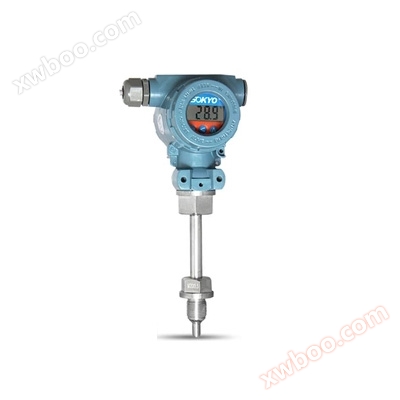
Equipped with temperature transmitter (explosion-proof) thermocouple resistor
Applications are usually used in conjunction with display instruments, recording instruments, electronic computers, etc., with an output of 4-20mA, to
Product details
application
Usually used in conjunction with display instruments, recording instruments, electronic computers, etc., it outputs 4-20mA and directly measures the gas quality of liquids, vapors, and solid surface temperatures within the range of -200 ℃ to 1300 ℃ in the presence of explosives such as carbon and chlorine compounds in the production site.
feature
Two line output 4-20mA, strong anti-interference ability;
Save the cost of compensating wires and installing temperature transmitters;
Large range of savings;
Cold end temperature automatic compensation, non-linear correction circuit;
working principle
The change in thermoelectric potential (resistance) measured by a thermocouple (resistor) in working state generates an unbalanced signal through the bridge of the temperature transmitter, which is amplified and converted into a 4-20mA electrical signal to the working instrument. The working instrument then displays the corresponding temperature value.
Explosion proof thermocouple (resistor) utilizes the principle of gap explosion-proof. When an explosion occurs inside the chamber, it can extinguish and cool through the gap between the joint surfaces, preventing the flame and temperature from being transmitted after the explosion
Outside the cavity for temperature measurement. The thermoelectric potential (resistance value) generated by the thermocouple (resistor) is amplified by the temperature transmitter's bridge to generate an unbalanced signal, which is then converted into a 4-20mA DC electrical signal and sent to the worker's instrument. The working instrument displays the corresponding temperature value.
Main technical parameters
Product execution standards
IEC584
IEC751
IEC1515
JB/T5518-91
IEC584
IEC751
IEC1515
JB/T5518-91
JB/T7391-94
Measurement range and tolerance
1) Temperature measurement range and tolerance of thermistor
| Model | Dividing number | measureTemperature range ℃ | essenceDegree level | allowable deviation |
| WZPB | Pt100 | -200-+500 |
A-levelBlevel
|
± (0.15 + 0.002 ITI)
± (0.30 + 0.005 ITI)
|
| WZCB | Cu50 Cu100 | -50-+100 | ± (0.30 + 0.005 ITI) |
2) Thermocouple temperature measurement range and tolerance
| Model | divideDegree number | Tolerance level | |||
| I | II | ||||
| Allowable deviation | Temperature measurement range ℃ | YunDifference | Temperature measurement range | ||
| WRNB | K | ±1.5℃ | -40-375 | ±2.5℃ | -40-333 |
| ± 0.004 ITI | 375-1000 | 0.0075% smile | 333-1200 | ||
| WRMB | N | ±1.5℃ | -40-375 | ±2.5℃ | -40-333 |
| ± 0.004 ITI | 375-1000 | 0.0075% smile | 333-1200 | ||
| WREB | E | ±1.5℃ | -40-375 | ±1.5℃ | -40-333 |
| ± 0.004 ITI | 375-800 | 0.004% smile | 333-900 | ||
| WRFB | J | ±1.5℃ | -40-375 | ±1.5℃ | -40-333 |
| ± 0.004 ITI | 375-750 | 0.004% smile | 333-750 | ||
| WRCB | T | ±1.5℃ | -40-125 | ±1℃ | -40-133 |
| ± 0.004 ITI | 125-350 | 0.0075% smile | 133-1000 | ||
Output signal: 4-20 mA, load resistance 250, transmission wire resistance 100
Output method: Two line system
Accuracy level:
Temperature transmitter accuracy level: 0.1 0.2 0.5
Display accuracy level: Analog indicator 2.5 level; Digital display level 0.5
Temperature transmitter accuracy level: 0.1 0.2 0.5
Display accuracy level: Analog indicator 2.5 level; Digital display level 0.5
Power supply: 24V DC ± 10 ℅
Protection level: IP65
Explosion proof grade:
Explosion proof type: d Ⅱ BT4 d Ⅱ CT5 d Ⅱ CT6
Intrinsic safety type: ia Ⅱ CT6
Explosion proof type: d Ⅱ BT4 d Ⅱ CT5 d Ⅱ CT6
Intrinsic safety type: ia Ⅱ CT6
Insulation resistance: The insulation resistance between the instrument output terminal and the housing should not be less than 50
Thermal response time:
When there is a step change in temperature, the time required for the current output signal of the instrument to change to 50% of the step change is usually represented by t0.5. When the step response stabilization time of the temperature transmitter does not exceed one-fifth of the thermocouple (resistance) thermal response stabilization time t0.5, the thermocouple (resistance) thermal response time is used as the thermal response time of the instrument; When the step thermal response stability time of the temperature transmitter does not exceed half of the thermocouple (resistance) thermal response stability time t0.5, the thermal response time of the temperature transmitter is used as the thermal response time of the instrument;
Basic error:
The basic error of the instrument should not exceed the combined error of the basic errors of the thermocouple (resistor) and temperature transmitter.
The basic error of the instrument should not exceed the combined error of the basic errors of the thermocouple (resistor) and temperature transmitter.
Online inquiry
-
Contacts
-
Company
-
Telephone
-
Email
-
WeChat
-
Verification Code
-
Message Content
-